
18 | Generation: How Many Choices Does One Sentence Take?
Build a Small Model, Understand Large Models · Lesson 18
“红色的苹果。” (“red apples”) appears on screen as six visible characters, yet the program makes seven choices. The final choice is not a displayed character but the end marker, EOS.
All seven choices use the same pretrained weights. Each selected character is appended to the input. After choosing “红”, the model predicts “色” from the new prefix that now includes “红”; together, “红色” means “red.”
Fix the prompt as 早上,小丁喜欢 (“In the morning, Xiaoding likes”) and record the prefix, chosen character, and stopping reason at each step.
Which Row Do We Take from the First Forward Pass?
The prompt has 7 characters, giving 8 positions after BOS is added. The model returns [1, 8, 79]. This does not mean it has already scored eight future characters. Position 0, containing BOS, predicts “早”; position 1 predicts “上”; and so on. The targets corresponding to the earlier rows already appear in the prompt.
The last position contains “欢”. It can read the whole known prompt, and its scores correspond to the next character we do not yet have. After receiving [1, 8, 79], take:
import torch
from tiny_lm.checkpoint import load_checkpoint

# 加载预训练参数、词表与配置;后续前向使用这份保存的参数。
model, tokenizer, _ = load_checkpoint("artifacts/first_run/pretrain.pt")
# 一个样本,BOS 加七个提示字符,形成 [1,8] 的已知前文。
inputs = torch.tensor([tokenizer.encode("早上,小丁喜欢", add_bos=True)])
# 模型输出 [1,8,79],只取最后位置预测尚未出现的下一项。
next_logits = model(inputs)[0, -1]  # 79 项分数
print(next_logits.shape)  # torch.Size([79])
This loads the author's supplied first_run/pretrain.pt, allowing you to verify the seven-step values in this lesson. If you have completed Lesson 17's training, replace the path with artifacts/my_run/pretrain.pt to use your own weights. The checkpoint restores its vocabulary and configuration as well. Check the step count in your pretrain_log.json before comparing generation results.
0 selects the first sample in the batch, and −1 selects the final position. Earlier positions still contribute to the contextual computation; we simply do not use their outputs to regenerate characters already present in the prompt.

The first choice is “红”, whose ID 55 is appended to the input. The next input grows from 8 entries to 9. Its last position now contains “红”, so it predicts the following “色”.
If the first choice had been another character, that character would have to be fed back instead. We cannot take another row from the original tensor as the second new character, because that row has never seen the choice just made. Using generated results as conditions for later generation is called autoregressive generation.
Choose the Most Probable Candidate, or Sample One?
The simplest method always chooses the highest-probability ID, called greedy selection. With the same parameters and input, this choice is deterministic. It compares candidates only at the current step; it does not list every possible sentence and choose the best whole sentence.
Another approach samples according to the probabilities. If three candidates have probabilities [0.1, 0.3, 0.6], the last is more likely to be drawn, but the first two also have a chance. Randomness enters at the selection step; the network still performs the same forward computation.
Before sampling, we can adjust the temperature τ:
p_j=exp(logit_j/τ)/Σ_k exp(logit_k/τ), τ>0
For scores [0, 1, 2], temperature 1 gives approximately [0.0900, 0.2447, 0.6652]; temperature 0.5 gives approximately [0.0159, 0.1173, 0.8668]; and temperature 2 gives approximately [0.1863, 0.3072, 0.5065].
Lower temperature favors high-scoring candidates more strongly; higher temperature gives other candidates more opportunity. The parameters do not change. Only the concentration of the sampling distribution changes, so temperature cannot fix facts the model learned incorrectly. The greedy branch does not use temperature.
Feed Each Chosen Character Back In
The loop only needs to retain the current ID sequence and repeat “forward pass, select, append.” IDs 0, 1, 2, and 3 are PAD, BOS, EOS, and UNK respectively. PAD, BOS, and UNK are forbidden outputs; EOS may be selected. Here is the algorithm as a standalone runnable function:
@torch.no_grad()
def continue_text(model, tokenizer, prompt, max_new_tokens=8,
                  greedy=False, temperature=.8, seed=42):
    """固定权重逐项生成,返回可见续写与停止原因;每次重算完整前缀,无 KV cache。"""
    if max_new_tokens < 0 or (not greedy and temperature <= 0):
        raise ValueError("新增长度不能为负,采样温度必须为正")
    tokens = [1] + tokenizer.encode(prompt)  # BOS 也占一个上下文位置。
    if 3 in tokens or len(tokens) > model.config.max_seq_len:
        raise ValueError("提示词含未知字符或超过上下文长度")
    device = next(model.parameters()).device
    # 随机数只用于采样,不修改模型权重;固定种子便于对照。
    rng = torch.Generator(device=device).manual_seed(seed)
    generated, reason = [], "max_new_tokens"
    model.eval()  # 切换评估模式;不建立反向记录由上面的 no_grad 装饰器负责。
    for _ in range(max_new_tokens):
        # 达到本模型的 32 项限制就停止,不裁掉旧字符继续写。
        if len(tokens) >= model.config.max_seq_len:
            reason = "context_limit"
            break
        # 当前全部前文 [1,T] 重新前向,取最后位置的 [V] 候选分数。
        inputs = torch.tensor([tokens], dtype=torch.long, device=device)
        logits = model(inputs)[0, -1].clone()
        # 禁止输出 PAD/BOS/UNK,保留 EOS;归一化后被禁项概率为 0。
        logits[[0, 1, 3]] = float("-inf")
        # 贪心不使用温度,采样才先除以 temperature;最后沿候选轴 Softmax。
        probabilities = (logits if greedy else logits / temperature).softmax(-1)
        if greedy:
            selected = int(probabilities.argmax())
        else:
            selected = int(torch.multinomial(probabilities, 1, generator=rng).item())
        # 选择结果接回输入,下一次前向才知道刚才选了哪个字。
        tokens.append(selected)
        if selected == 2:
            # EOS 也消耗一次选择,但不加入返回的可见文本。
            reason = "eos"
            break
        generated.append(selected)
    return tokenizer.decode(generated), reason

print(continue_text(model, tokenizer, "早上,小丁喜欢", greedy=True))
# ('红色的苹果。', 'eos')
argmax takes the largest entry; multinomial samples an ID according to its probability. tokens.append(selected) adds the new character to the next forward pass's input. @torch.no_grad() disables backward recording, and the loop contains no parameter-updating step().
The three special entries set to negative infinity receive probability zero, and all permitted outputs are normalized together. The companion generate function also records the top five candidates at each step and restores the model's previous mode. These bookkeeping operations do not change the selection algorithm.
This implementation recomputes the entire prefix at every step and has no KV cache. The context limit is 32 entries, including BOS. A longer prompt raises an error. Once the loop already has 32 entries, it stops instead of dropping old characters and continuing. A shorter prompt may stop earlier on EOS or exhaust the allowed number of new tokens.
EOS signals completion; it is not displayed text. It is recorded in the step log but omitted from the returned visible text. Thus “at most 8 new tokens” does not guarantee 8 visible characters on screen.
Review the Seven Choices
Load the pretrained weights from Lesson 17 and use greedy selection. The log numbers these seven steps starting at 0:
| Step | Number of input IDs | Choice | Probability of that choice, approximately |
|---|---|---|---|
| 0 | 8 | 红 | 0.999767 |
| 1 | 9 | 色 | 0.999943 |
| 2 | 10 | 的 | 0.999990 |
| 3 | 11 | 苹 | 0.999931 |
| 4 | 12 | 果 | 0.999981 |
| 5 | 13 | 。 | 0.999900 |
| 6 | 14 | EOS | 0.999968 |
Each of the first six steps appends one character. At the seventh, the model reads the final period and selects EOS. These probabilities mask the three special entries, differing slightly in definition from the full 79-entry distribution in Lesson 16. The characters form “红色” (“red”), the linking particle “的”, “苹果” (“apple”), and the period “。”; their individual token boundaries remain Chinese character boundaries.
Watch the animated walkthrough
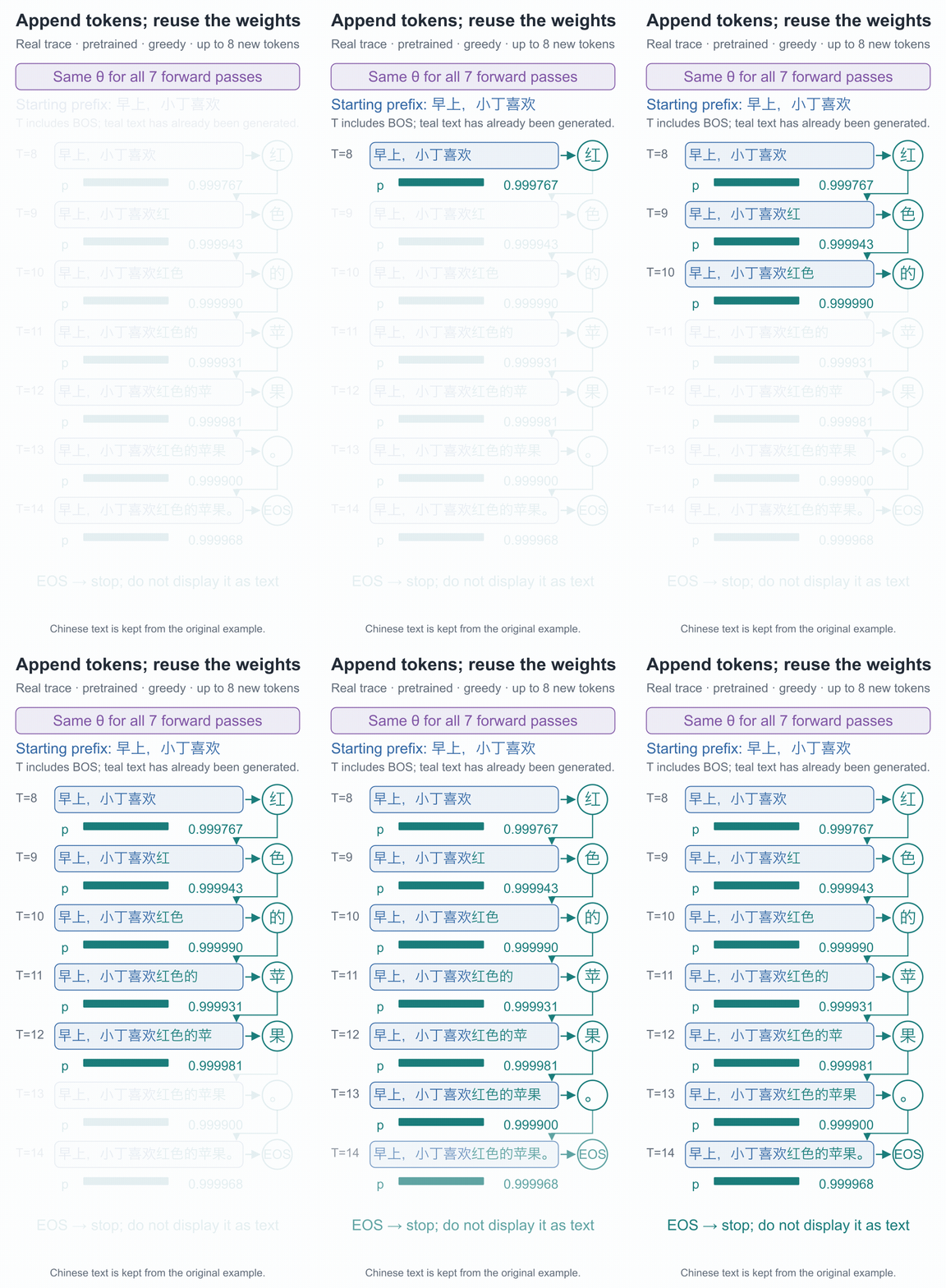
Pause step by step in the interactive demo to inspect prefixes and candidates. The static figure below expands the first choice and compares two sampling results.
Try it here · Step-by-step experimentStep through the calculation, forwards or backwards.
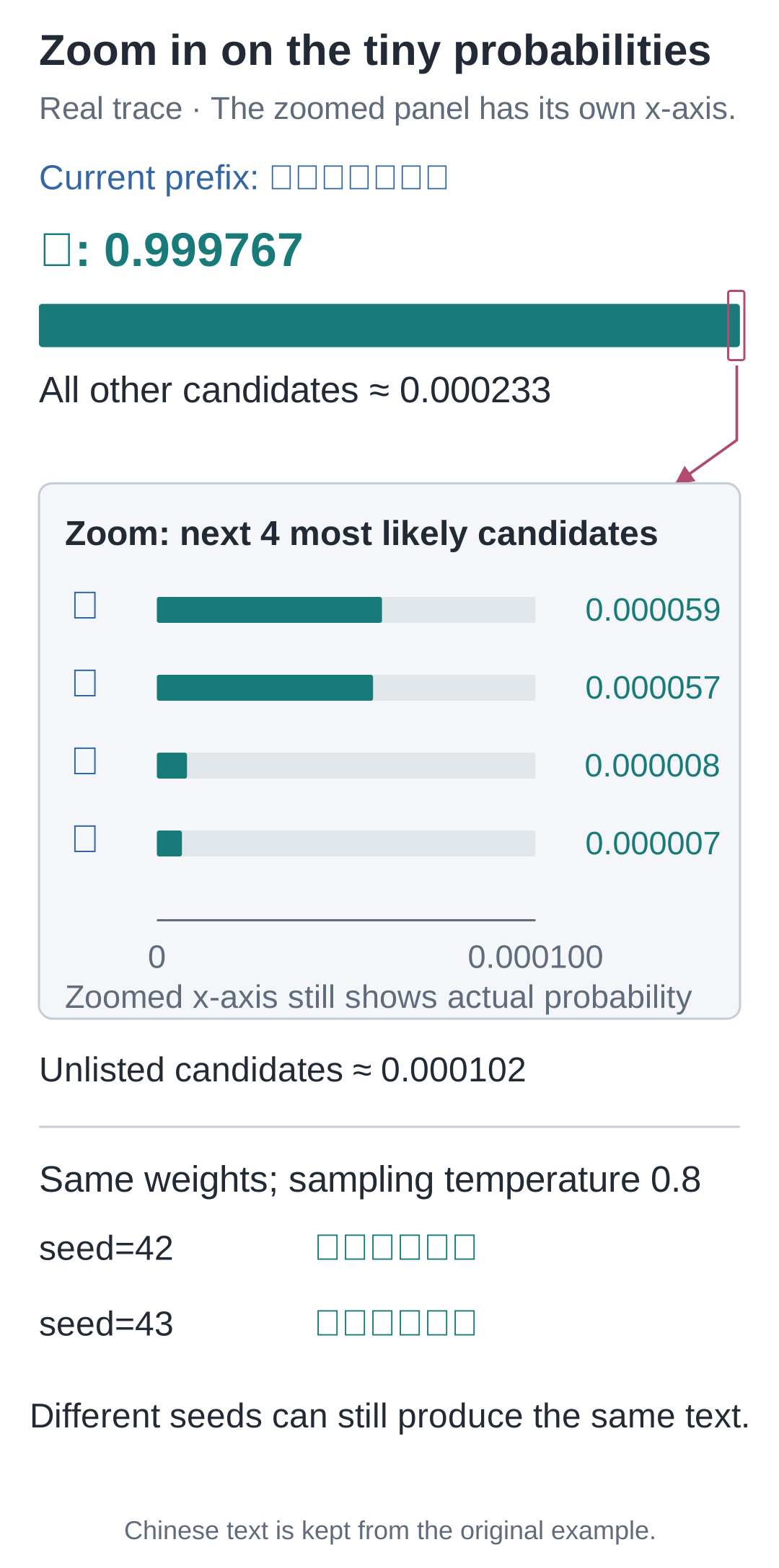
The upper bar for “红” uses a 0-to-1 scale, while the enlarged lower region has an axis maximum of only 0.000100. The probabilities themselves have not changed. Bar lengths across the two regions are not directly comparable.
Is the Model Still Learning During This Process?
Fix the pretrained weights, set temperature to 0.8, and use seeds 42 and 43. Both samples in this run produce “红色的苹果。”. The stepwise distributions are highly concentrated, so different seeds can still draw the same sequence. “Random sampling” does not mean “a different result every time.”
Compare parameter digests before and after generation to check whether parameters changed during these seven steps. The following calls the companion implementation and also obtains the step log:
from tiny_lm.trace import parameter_digest
from tiny_lm.generate import generate

# 比较生成前后的参数值;输入会增长,参数应保持同一份。
before = parameter_digest(model)
result = generate(model, tokenizer, "早上,小丁喜欢", greedy=True)
assert parameter_digest(model) == before
print(result["generated_text"], result["stop_reason"])
The vocabulary, configuration, and parameters saved in a checkpoint must be loaded together. Pairing weights with an arbitrary character-ID table may change which character each ID represents, even when the shapes match.
Run the supplied entry point from the code companion code directory.
If you completed Lesson 17's training, generate with your own weights:
# 使用第17讲亲手训练并保存的权重。
python -m lessons.l18 --checkpoint artifacts/my_run/pretrain.pt --prompt '早上,小丁喜欢' --greedy
To verify the record in this lesson, run the following two commands with the author's weights, using greedy selection and random sampling respectively:
# 加载指定权重并生成文字;本命令不更新参数。
python -m lessons.l18 --checkpoint artifacts/first_run/pretrain.pt --prompt '早上,小丁喜欢' --greedy
# 加载指定权重并生成文字;本命令不更新参数。
python -m lessons.l18 --checkpoint artifacts/first_run/pretrain.pt --prompt '早上,小丁喜欢' --temperature 0.8
Optional: can we avoid rereading the entire prefix each time?
When generating the second character, we feed the entire prefix through the model again. But with fixed parameters and causal restrictions, old positions cannot read newly appended characters. Their previously computed K and V vectors at each layer can therefore be retained and reused. The new position computes its own query and reads the old cache together with the newly added K/V.
This is a KV cache. It stores intermediate results from the current generation; it does not update model parameters.
Run four actual steps with Qwen3-0.6B, the model inspected in Lesson 16, and count the inputs at each step. The first input contains all 16 tokens. Every later step inputs just 1 new token, while the first layer's cache grows to 17, 18, and 19 positions.

The four chosen tokens are “天空”, “的颜色”, “通常”, and “被认为是”, roughly “the sky,” “its color,” “usually,” and “is considered to be.” A token in this public model may span several Chinese characters, so four tokens produce more than four characters. We observed only these first four steps, not a complete answer.
At the fourth step, recomputing all 19 entries without a cache produces candidate scores whose maximum difference from the cached version is about 0.0000725, due to floating-point rounding. Both methods select the same next token. The original record stores the shapes, candidates, and parameter digests.
Two Prediction Questions
- If two forward passes with identical input and weights produce identical logits, why can sampled text still differ? Conversely, does identical sampled text prove no random selection occurred?
- When temperature changes from 1 to 0.5, can another candidate become the highest-probability candidate? Can the candidate actually drawn by sampling change?
Reference answers
For question one, the forward pass determines the distribution, while the random process also determines which ID is drawn. The same distribution can produce different draws or repeat the same draw. For question two, dividing by a positive temperature preserves score ranking, so the largest entry stays the largest. But candidate probabilities change, so the choice associated with the same random process may change. Do not confuse the distribution's most probable candidate with the actual result of one sample.
Code and generation records: Lesson runner · Generation implementation · Step logs for all three stages.
Source navigation: generate.py · generate.